what do medical workers use a sphygmomanometer to measure

BP 138/73 mmHg as result on electronic sphygmomanometer
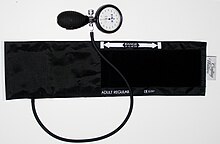
Aneroid sphygmomanometer with an adult gage

Aneroid sphygmomanometer dial, bulb, and air valve

Clinical mercury manometer
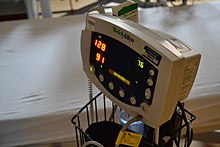
Clinical WelchAllyn sphygmomanometer
A sphygmomanometer ( SFIG-moh-mə-NO-mi-tər), likewise known equally a blood force per unit area monitor, or blood pressure level estimate, is a device used to measure blood force per unit area, composed of an inflatable cuff to collapse and and so release the artery under the cuff in a controlled style,[ane] and a mercury or aneroid manometer to measure the pressure level. Transmission sphygmomanometers are used with a stethoscope when using the auscultatory technique.
A sphygmomanometer consists of an inflatable cuff, a measuring unit (the mercury manometer, or aneroid gauge), and a machinery for inflation which may be a manually operated bulb and valve or a pump operated electrically.
Types [edit]
Both manual and digital meters are currently employed, with different merchandise-offs in accuracy versus convenience.
Transmission [edit]
A stethoscope is required for auscultation (see below). Transmission meters are best used by trained practitioners, and, while it is possible to obtain a bones reading through palpation lonely, this yields only the systolic pressure.
- Mercury sphygmomanometers are considered the golden standard. They indicate pressure with a column of mercury, which does not require recalibration.[2] Because of their accuracy, they are ofttimes used in clinical trials of drugs and in clinical evaluations of high-run a risk patients, including pregnant women. A oftentimes used wall mounted mercury sphygmomanometer is too known as a Baumanometer.[3]
- Aneroid sphygmomanometers (mechanical types with a dial) are in common use; they may require calibration checks, dissimilar mercury manometers. Aneroid sphygmomanometers are considered safer than mercury sphygmomanometers, although inexpensive ones are less accurate.[iv] A major cause of departure from calibration is mechanical jarring. Aneroids mounted on walls or stands are not susceptible to this particular problem.
Digital [edit]
Digital meters employ oscillometric measurements and electronic calculations rather than auscultation. They may employ transmission or automatic inflation, just both types are electronic, easy to operate without grooming, and can be used in noisy environments. They measure systolic and diastolic pressures by oscillometric detection, employing either deformable membranes that are measured using differential capacitance, or differential piezoresistance, and they include a microprocessor.[5] They mensurate mean blood pressure and pulse rate, while systolic and diastolic pressures are obtained less accurately than with manual meters,[six] and scale is besides a concern.[vii] [8] [9] Digital oscillometric monitors may not exist appropriate for some patients, such as those suffering from arteriosclerosis, arrhythmia, preeclampsia, pulsus alternans, and pulsus paradoxus, as their calculations may non correct for these weather,[10] [11] and in these cases, an analog sphygmomanometer is preferable when used by a trained person.
Digital instruments may utilise a cuff placed, in society of accuracy[12] and inverse gild of portability and convenience, around the upper arm, the wrist, or a finger.[13] Recently, a group of researchers at Michigan State University developed a smartphone based device that uses oscillometry to judge blood force per unit area.[xiv] [xv] The oscillometric method of detection used gives claret pressure readings that differ from those adamant by auscultation, and vary co-ordinate to many factors, such as pulse pressure, heart rate and arterial stiffness,[16] although some instruments are claimed as well to measure arterial stiffness, and some can detect irregular heartbeats.
Operation [edit]
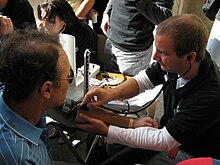
Medical pupil taking claret force per unit area at the brachial artery
In humans, the cuff is normally placed smoothly and snugly around an upper arm, at roughly the same vertical summit as the eye while the subject is seated with the arm supported. Other sites of placement depend on species and may include the flipper or tail. It is essential that the correct size of cuff is selected for the patient. Besides pocket-size a cuff results in also high a pressure, while likewise large a cuff results in too low a pressure level. For clinical measurements it is usual to measure and tape both artillery in the initial consultation to determine if the pressure is significantly higher in 1 arm than the other. A difference of 10 mm Hg may exist a sign of coarctation of the aorta. If the artillery read differently, the higher reading arm would exist used for later readings.[17] The gage is inflated until the artery is completely occluded.
With a manual musical instrument, listening with a stethoscope to the brachial artery, the examiner slowly releases the pressure in the cuff at a rate of approximately 2 mm per heart beat. As the force per unit area in the cuffs falls, a "whooshing" or pounding audio is heard (see Korotkoff sounds) when blood catamenia first starts again in the avenue. The pressure level at which this sound began is noted and recorded as the systolic blood pressure. The cuff pressure is further released until the sound can no longer be heard. This is recorded equally the diastolic blood force per unit area. In noisy environments where auscultation is impossible (such every bit the scenes ofttimes encountered in emergency medicine), systolic blood pressure alone may exist read by releasing the pressure level until a radial pulse is palpated (felt). In veterinary medicine, auscultation is rarely of use, and palpation or visualization of pulse distal to the sphygmomanometer is used to detect systolic pressure level.
Digital instruments use a cuff which may be placed, according to the instrument, effectually the upper arm, wrist, or a finger, in all cases elevated to the same tiptop as the heart. They inflate the cuff and gradually reduce the force per unit area in the aforementioned way as a manual meter, and measure blood pressures by the oscillometric method.[5]
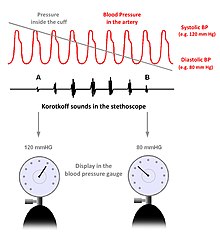
Caption of how blood pressure is measured based on Korotkow sounds
Significance [edit]
By observing the mercury in the column, or the aneroid judge pointer, while releasing the air pressure with a control valve, the operator notes the values of the blood pressure in mm Hg. The meridian pressure in the arteries during the cardiac wheel is the systolic pressure, and the lowest pressure (at the resting phase of the cardiac cycle) is the diastolic force per unit area. A stethoscope, practical lightly over the artery beingness measured, is used in the auscultatory method. Systolic pressure (starting time phase) is identified with the first of the continuous Korotkoff sounds. Diastolic pressure is identified at the moment the Korotkoff sounds disappear (5th phase).
Measurement of the blood force per unit area is carried out in the diagnosis and treatment of hypertension (high blood pressure), and in many other healthcare scenarios.
History [edit]

The sphygmomanometer was invented by Samuel Siegfried Karl Ritter von Basch in the yr 1881.[1] Scipione Riva-Rocci introduced a more easily used version in 1896. In 1901, pioneering neurosurgeon Dr. Harvey Cushing brought an example of Riva-Rocci'south device to the United states of america, modernized information technology and popularized it within the medical customs. Further comeback came in 1905 when Russian medico Nikolai Korotkov included diastolic blood pressure measurement following his discovery of "Korotkoff sounds." William A. Baum invented the Baumanometer make in 1916,[18] while working for The Life Extension Institute which performed insurance and employment physicals.[3] In 1981 the get-go fully automated oscillometric blood pressure gage was invented by Donald Nunn.[nineteen]
Etymology [edit]
The word sphygmomanometer (, SFIG-moh-mə-NOM-i-tər) uses the combining form of sphygmo- + manometer. The roots involved are every bit follows: Greek σφυγμός sphygmos "pulse", plus the scientific term manometer (from French manomètre), i.east. "pressure level meter", itself coined from μανός manos "sparse, sparse", and μέτρον metron "mensurate".[20] [21] [22]
About sphygmomanometers were mechanical gauges with dial faces, or mercury columns, during most of the 20th century. Since the appearance of electronic medical devices, names such equally "meter" and "monitor" can besides apply, as devices can automatically monitor blood pressure on an ongoing basis.
References [edit]
- ^ a b Booth, J (1977). "A short history of blood pressure measurement". Proceedings of the Majestic Order of Medicine. seventy (xi): 793–nine. doi:ten.1177/003591577707001112. PMC1543468. PMID 341169.
- ^ "Comparing Mercury and Aneroid Sphygmomanometers". Sustainable Hospitals / Lowell Middle for Sustainable Production. Sustainable Hospitals / Lowell Center for Sustainable Production. 2003. Retrieved 23 February 2015.
- ^ a b "Turning Mercury Into Solid Gold". nytimes.com. 2005-03-27. Retrieved 2018-07-05 .
- ^ Misrin, J. "Aneroid Sphygmomanometer: A Battle for Safer Blood Force per unit area Apparatus". Retrieved 27 February 2012.
- ^ a b Oscillometry, Caption of oscillometric detection in Medical Electronics, N Townsend, p48-51
- ^ "Oscillometric Method - Methods of Claret Pressure Measurement - Measurement of Blood PressureMethods of Blood Pressure Measurement -". world wide web.severehypertension.internet. 22 December 2007. Retrieved 2017-04-13 .
- ^ Can nosotros trust automated sphygmomanometer validations? Turner MJ. Periodical of Hypertension. 28(12), December 2010, pp. 2353–2356 doi:ten.1097/HJH.0b013e32833e1011.
- ^ Automated Sphygmomanometers Should Not Replace Manual Ones, Based on Current Testify Martin J. Turner and Johan M. van Schalkwyk American Journal of Hypertension. 21(8), p. 845.
- ^ Sphygmomanometer scale--why, how and how ofttimes? Turner MJ1, Speechly C, Bignell N. Australian Family unit Dr.. Oct 2007; 36(10):834-838.
- ^ Hamzaoui O, Monnet X, Teboul JL (2013). "Pulsus paradoxus". Eur. Respir. J. 42 (6): 1696–705. doi:10.1183/09031936.00138912. PMID 23222878.
- ^ O'Brien Due east, Asmar R, Beilin Fifty, Imai Y, Mallion JM, Mancia G, Mengden T, Myers G, Padfield P, Palatini P, Parati G, Pickering T, Redon J, Staessen J, Stergiou Yard, Verdecchia P (2003). "European Society of Hypertension recommendations for conventional, ambulatory and home blood force per unit area measurement". J. Hypertens. 21 (5): 821–48. doi:10.1097/00004872-200305000-00001. PMID 12714851. S2CID 3952069.
- ^ Mourad, Adnan; Gillies, Alastair; Carney, Shane (2005). "Inaccuracy of wrist-cuff oscillometric blood pressure devices: an arm position artefact?" (PDF). Clinical Methods and Pathophysiology. ten (2): 67–71. doi:10.1097/00126097-200504000-00003. PMID 15812253. S2CID 6100566.
- ^ "Blutdruckmessgerät - Handgelenk - Blutdruckmessgerät - Test" (in German). Blutdruckmessgeraet-vergleich-test.de. Retrieved 27 September 2016.
- ^ Chandrasekhar, Anand (2018-03-07). "Smartphone-based blood pressure monitoring via the oscillometric finger-pressing method". Science Translational Medicine. 10 (431): eaap8674. doi:10.1126/scitranslmed.aap8674. PMC6039119. PMID 29515001.
- ^ Chandrasekhar, Anand (2018-09-03). "An iPhone Application for Blood Pressure Monitoring via the Oscillometric Finger Pressing Method". Scientific Reports. viii (i): 13136. Bibcode:2018NatSR...813136C. doi:10.1038/s41598-018-31632-x. PMC6120863. PMID 30177793.
- ^ van Montfrans GA (2001). "Oscillometric blood force per unit area measurement: progress and problems". Blood Printing Monit. 6 (half dozen): 287–90. doi:x.1097/00126097-200112000-00004. PMID 12055403.
- ^ Fred, H. L. (2013). "Accurate Blood Pressure Measurements and the Other Arm". Texas Heart Institute Periodical. 40 (3): 217–219. PMC3709227. PMID 23914007.
- ^ U.S patent 1594039 Manometer
- ^ Apparatus and method for measuring blood pressure
- ^ Harper, Douglas. "sphygmomanometer". Online Etymology Dictionary.
- ^ Harper, Douglas. "manometer". Online Etymology Lexicon.
- ^ σφυγμός , μανός , μέτρον . Liddell, Henry George; Scott, Robert; A Greek–English Lexicon at the Perseus Project.
External links [edit]
- US patent 1089122, Francis Ashley Faught, Charles J Pilling, "Appliance for measuring and indicating claret-pressure level", issued 1914-03-03
- Usa patent 1594039, William A Baum, "Manometer", issued 1926-07-27
- Usa patent 2560237, R. H. Miller, "Sphygmomanometer", issued 1951-07-10
- US patent 6752764, Man S. Oh, "Pocket sphygmomanometer", issued 2004-06-22
Source: https://en.wikipedia.org/wiki/Sphygmomanometer

Post a Comment for "what do medical workers use a sphygmomanometer to measure"